What is flamenco
www.MelbourneFlamenco.com
Flamenco Dance Classes and Flamenco Performers Available.
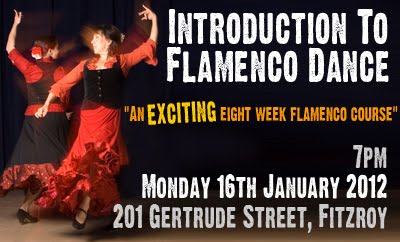
Simply put, Flamenco is a form of singing, guitar playing, and dance, incorporating percussive foot stamping and hand clapping, that comes from Andalusia in Southern Spain.
Historically it has been a cultural outlet for the poor and oppressed. I think of it as the Blues of Southern Spain.
Think of a gypsy camp on the edge of town; a fire is burning and the families gather around it.
They may have been travelling a long time and not been allowed to stay in one place for long. They have been not accepted, not trusted, yet not allowed to work and make money like the local citizens.
Stories are told around that fire; poems in song. Expressions of a day, a week, hard times or good. Love stories often, unrequited love even more, but flamenco embraces all human emotions.
The guitar accompanies the stories. Shouts of encouragment help the story. Clapping helps the rhythm of the guitar. When the song is a sad tale, the song has a wailing mournful quality, when it is happy and playful, the whole thing speeds up. The clapping becomes rhythmical and playful and a dancer may feel it in himself to get up and express the emotions inside him. (or her)
The group shouts Jaleos (cries of encouragement) Ole! Well done
Everyone is involved; small children, the old people; tall, short, fat ,thin. everyone.
As long as you have the compas.
Compas is timing. Compas is rhythm. To be in compas is to be in time. Compas is everything.
Flamenco is known as a gypsy art form, but it also has influences from the Moorish, Byzantine and Sephardic Jewish, and Spanish people who lived in the region. The guitar as an instrument has long been associated with Spain and is a big part of it.
It is believed that the Spanish gypsies came originally from India in a series of migrations.
They called themselves Rom and their language was Calo.
The different cities in Andalucia invented and brought forth different palos or styles of Flamenco.
Some palos are counted in twelves and some in fours.
There are many of these and each has it’s own history.
I won’t try to tell them here.
Flamenco has an enormously rich tradition and culture with many branches. It’s guitarists and dancers are of the highest quality of exponents of any art form. It takes time to learn about it, but it is very much worth taking the time.
Today flamenco is a highly evolved art form capable of mesmerising the world, but not very well understood in Australia yet. I commend all the Australian exponents, students and teachers, singers and dancers, guitarists and aficionados including occasional guest teachers from Spain which we are so lucky to have.
Tatiana